
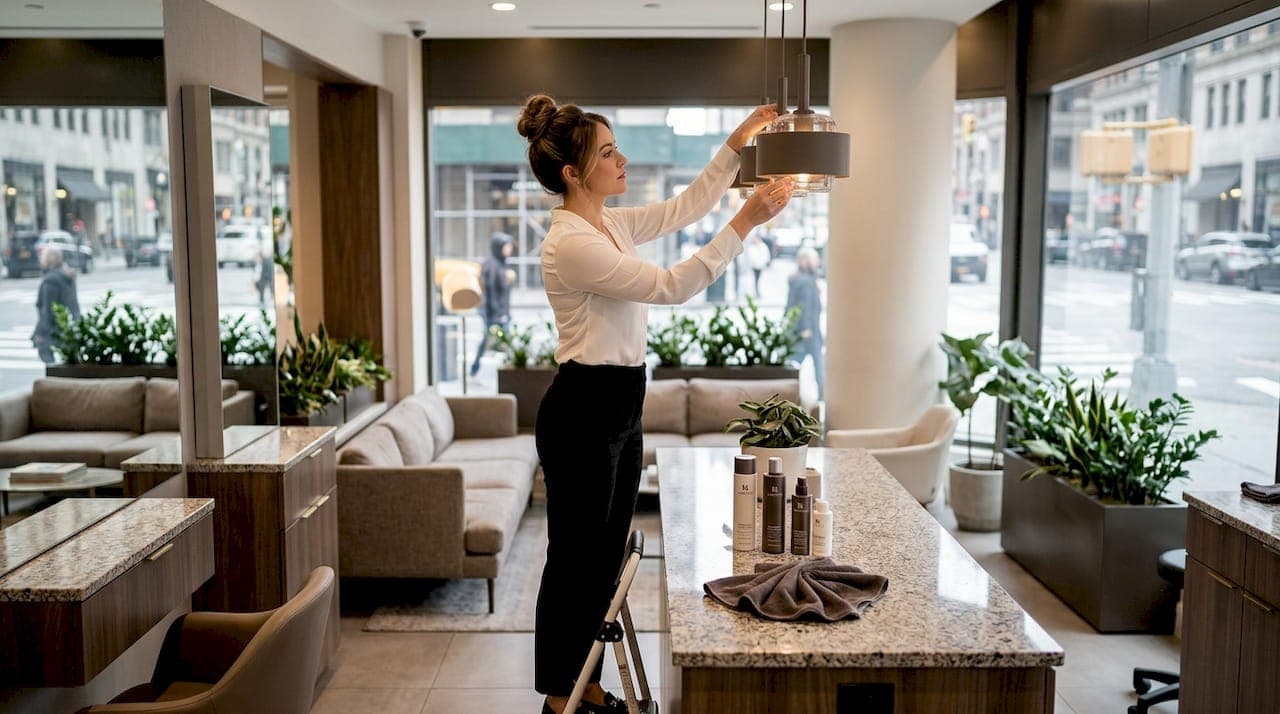
Walk into the wrong salon and you feel it immediately. Something is off. The lighting is too bright, the music too loud, the chairs too close together. Now walk into the right one. You exhale before you even sit down. That shift is not accidental. The luxury salon atmosphere elements that separate a forgettable visit from a genuinely transformative one are specific, deliberate, and deeply sensory. Understanding what they are helps you recognize real luxury when you find it, and know exactly what you deserve.
Table of Contents
- Key takeaways
- 1. Layered lighting as the foundation of luxury salon atmosphere elements
- 2. Sensory and acoustic zoning for privacy and calm
- 3. Luxurious materials and textures that signal exclusivity
- 4. Thoughtful amenities and finishing touches
- 5. Curated retail displays that reinforce the experience
- 6. The client journey as a sequence of sensory transitions
- 7. Clutter control and spatial discipline
- My honest take on what luxury actually means in a salon
- Experience these elements firsthand at Salonrituel
- FAQ
Key takeaways
| Point | Details |
|---|---|
| Lighting sets the tone | Warm, layered lighting at 2700K–3000K creates a relaxed, upscale mood that flat overhead lighting never achieves. |
| Cohesion matters more than cost | Mismatched surfaces and clutter undermine luxury perception even when individual pieces are expensive. |
| Sensory zoning defines the journey | Distinct zones for entry, waiting, styling, and checkout create an evolving experience rather than a flat one. |
| Small details signal big intentions | Signature scents, curated refreshments, and quality music are what clients remember long after they leave. |
| Privacy is a luxury feature | Thoughtful spatial design that creates intimacy without enclosing walls is a hallmark of premium salon environments. |
1. Layered lighting as the foundation of luxury salon atmosphere elements
Lighting is the single most powerful and most frequently mishandled element in high-end salon decor. Most salons default to flat, cool overhead fluorescents. The result feels clinical. Luxury salons do something fundamentally different: they layer light.
The approach works in three distinct tiers. Ambient lighting sets the overall mood and warmth of the space. Task lighting gives stylists the precision they need without washing out the room. Accent lighting draws the eye toward retail displays, architectural details, or statement art pieces.
High-end salons use lighting at 2700K to 3000K color temperature to produce that warm, golden quality that makes clients feel relaxed and looked after. Go cooler than that and the space starts to feel like a hospital. Go warmer and it becomes murky. The 2700K to 3000K range is the sweet spot.
Key lighting choices that separate premium salons from average ones:
- Dimmers on every circuit to shift mood from morning energy to afternoon calm
- Pendant lighting over styling stations to add architectural interest
- Backlit mirrors that eliminate harsh shadows during consultations
- Recessed accent lighting in retail niches to make products feel curated
- Warm sconce lighting in waiting areas to signal comfort and arrival
Pro Tip: If you are evaluating a salon's luxury credentials, look up. The ceiling tells you everything. Exposed fluorescent tubes signal cost-cutting. Layered, warm, dimmable fixtures signal investment in your experience.
2. Sensory and acoustic zoning for privacy and calm
A salon that sounds like a busy restaurant is not a luxury salon. Sound is one of the most underestimated elements of a premium spa atmosphere, and the best salon designers treat it with the same seriousness as lighting or materials.
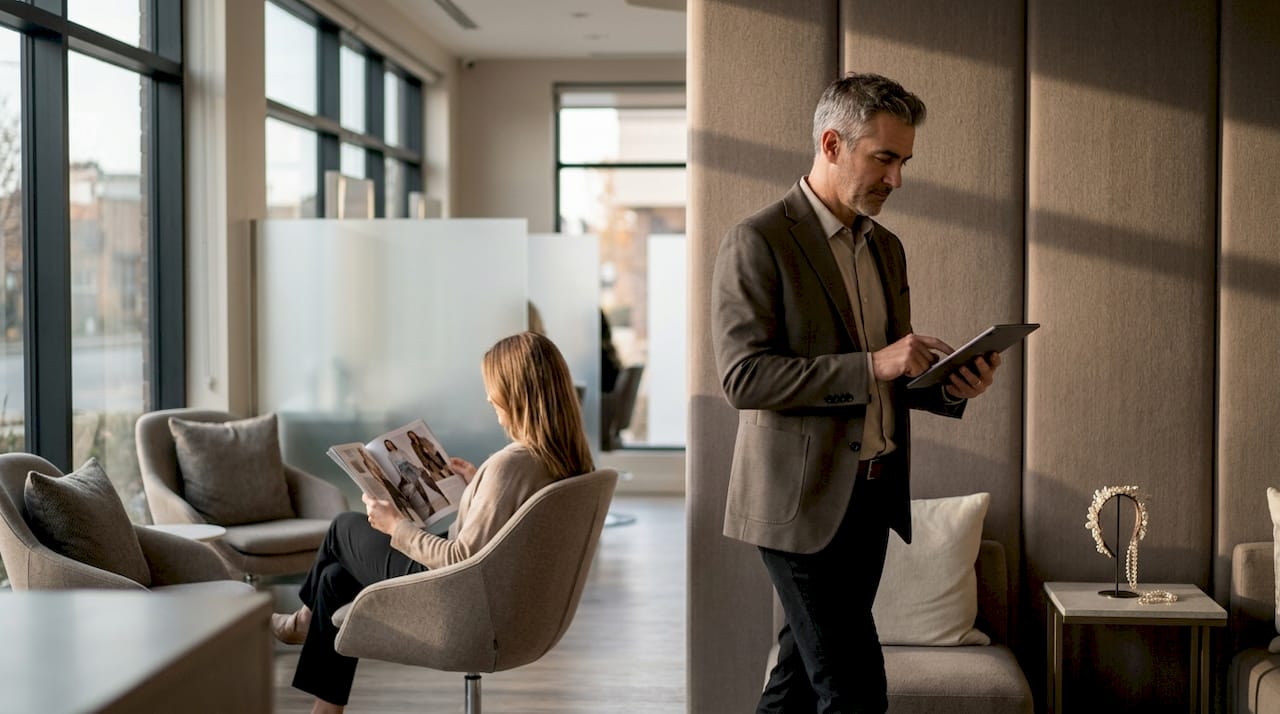
Salons use floor-standing mirrors and silicone panels to create privacy pockets that feel intimate without being enclosed. This approach preserves the open, airy quality of a well-designed space while giving each client a sense of personal territory. You feel attended to rather than processed.
Multi-zone audio is the other half of this equation. Audio design includes volume controls by zone so the waiting area can carry a softer, more ambient playlist while the styling floor has slightly more energy. The two experiences feel distinct without jarring transitions.
"Luxury atmosphere can come from choreography and privacy staging rather than mere decoration or ornamentation." — SBID design insight
Acoustic panels, upholstered walls, and heavy textiles all absorb sound and reduce the echo that makes busy salons feel chaotic. When a space is acoustically calm, clients unconsciously lower their guard. That relaxation is the foundation of trust, and trust is the foundation of a loyal client relationship.
3. Luxurious materials and textures that signal exclusivity
Touch and sight work together in a luxury hair salon design. The materials you encounter, from the chair you sit in to the countertop beside you, send continuous signals about the caliber of the experience.
Velvet upholstery in waiting areas communicates softness and care before a single service begins. Marble tabletops and polished wood accents add visual weight and permanence. These are not just aesthetic choices. They are tactile promises.
The table below shows how material choices translate directly into client perception:
| Material | Perception created | Common placement |
|---|---|---|
| Velvet upholstery | Warmth, comfort, exclusivity | Waiting chairs, accent seating |
| Honed marble | Sophistication, permanence | Reception desk, side tables |
| Polished wood | Natural warmth, craftsmanship | Shelving, styling station frames |
| Brushed brass hardware | Refined elegance | Cabinet pulls, mirror frames |
| Textured linen or wool | Calm, organic luxury | Wall panels, throw accents |
Luxury perception requires consistent style, clean lines, and integrated storage to avoid a crowded appearance. The restraint is the point. A salon that tries to use every premium material at once ends up looking busy rather than beautiful. The most elegant salon interiors commit to a palette of three to four materials and execute them with precision.
Natural light, when available, amplifies every material in the space. Marble glows differently in afternoon sun than under artificial light. Designers working on exclusive salon environments often orient key areas to capture that natural shift across the day.
4. Thoughtful amenities and finishing touches
The difference between a good salon and a genuinely memorable one often lives in the details that have nothing to do with the actual service. These are the moments between moments: what happens while you wait, while your color processes, while you check out.
Beverage service presentation adds measurable refinement to the client experience. Infused water in glass carafes, an espresso station, or a small selection of herbal teas signals that your comfort matters beyond the chair. It is hospitality, not just service.
Amenities that consistently define elements of a lavish salon:
- Infused water or sparkling water served in branded glassware
- Espresso or specialty tea available on request
- High-speed Wi-Fi with a clearly posted, easy password
- Charging stations built into waiting area furniture
- Warm towels or neck wraps during processing time
- Branded robe or cape options that feel intentional rather than functional
Clean, light fragrances are preferred over heavy perfumes in luxury environments. A signature scent, diffused subtly throughout the space, becomes part of the brand identity. Clients begin to associate that scent with relaxation and quality. It is one of the most powerful and least expensive atmosphere tools available.
Pro Tip: The best signature scents for salon environments lean toward clean florals, light woods, or fresh citrus. Avoid anything that competes with chemical service smells or overwhelms clients with sensitivities.
5. Curated retail displays that reinforce the experience
Most salons treat retail as an afterthought. Products get stacked on shelves, price tags face outward, and the display looks more like a pharmacy than a boutique. In a luxury salon, retail is part of the atmosphere.
Overstocked shelves reduce perceived value. Spacing and symmetry enhance sophistication. When products are given room to breathe, they look like they belong in a curated collection rather than a clearance bin. This is the same principle that separates a luxury boutique from a discount retailer.
Accent lighting above retail niches, as mentioned in the lighting section, does a significant amount of work here. A well-lit product on a clean shelf with intentional spacing looks premium. The same product crowded among twenty others looks ordinary. The product has not changed. The context has.
Branded packaging and consistent color families within the retail display extend the salon's visual identity into the product selection. Clients who feel the atmosphere is cohesive are significantly more likely to trust the product recommendations that come with it.
6. The client journey as a sequence of sensory transitions
This is where truly exceptional salon design separates itself from everything else. Designing the client journey as a sequence of sensory transitions is the hallmark of premium salon build-outs. A flat, one-size-fits-all ambiance signals a lower-end experience, even when individual elements are expensive.
Think of the journey in five distinct phases:
- Entry. First impression zone. Lighting slightly brighter to welcome, scent most present, reception design clean and uncluttered.
- Waiting. Comfort and calm. Softest lighting, lowest music volume, most tactile materials within reach.
- Washing. Sensory indulgence. Warm lighting, gentle music, warm towels, and the physical sensation of the service itself.
- Styling. Energy and focus. Slightly more dynamic music, task lighting precise but warm, conversation natural and engaged.
- Checkout. Confident close. Clean, organized, unhurried. The last impression should feel as intentional as the first.
Salons melt spaces into one another using tonal palettes inspired by times of day, so each transition feels natural rather than abrupt. The client does not consciously notice the shift. They simply feel progressively more at ease, or energized, or satisfied, depending on where they are in the experience.
Sensory transitions across zones use lighting, sound, and scent shifts from entry to checkout to maintain freshness and calm throughout. This is how to create a luxury salon experience that clients describe as "different" without being able to articulate exactly why.
7. Clutter control and spatial discipline
Simply adding expensive furniture items or chandeliers without cohesive layout and clutter control does not create genuine luxury. This is the mistake most salons make when they try to upgrade their environment. They add. Luxury requires the discipline to subtract.
Clutter is the enemy of perceived value. Visible product overflow, tangled cords at styling stations, mismatched storage solutions, and crowded reception desks all undermine the atmosphere regardless of what else the space gets right. Integrated storage, cord management, and disciplined editing of what is on display are non-negotiable in an exclusive salon environment.
Luxury perception requires consistent style and clean lines throughout. Every surface a client can see should be intentional. If something does not contribute to the atmosphere or serve a clear functional purpose, it should not be visible.
The spatial discipline extends to furniture placement. Chairs spaced generously, clear pathways between stations, and a waiting area that does not feel like a crowded waiting room all communicate that the salon values the client's physical comfort as much as the service itself.
My honest take on what luxury actually means in a salon
I have spent years working with beauty brands and visiting premium salons across the country, and the pattern I keep seeing is this: the salons that feel genuinely luxurious are almost never the ones with the most expensive chandeliers. They are the ones where every decision, from the temperature of the lighting to the scent in the air to the spacing of the chairs, feels like it was made with a specific client experience in mind.
Luxury is principally about perception. A chaotic or mismatched environment lowers perceived value even when the services themselves are exceptional. I have been in salons charging top-tier prices that felt frantic and impersonal. I have been in mid-priced salons that felt genuinely indulgent because someone thought carefully about the sensory experience.
What I find most underrated is privacy. Not walls and closed doors, but the feeling that the space was designed for you specifically. Large mirrors used as partitions balance visibility and client comfort in a way that feels sophisticated rather than isolating. That balance, between openness and intimacy, is where real luxury lives.
My honest advice: stop looking for the most expensive option and start looking for the most intentional one. Cohesion, sensory storytelling, and genuine attention to the client journey will always outperform a big budget spent without a clear design narrative.
— Victor
Experience these elements firsthand at Salonrituel
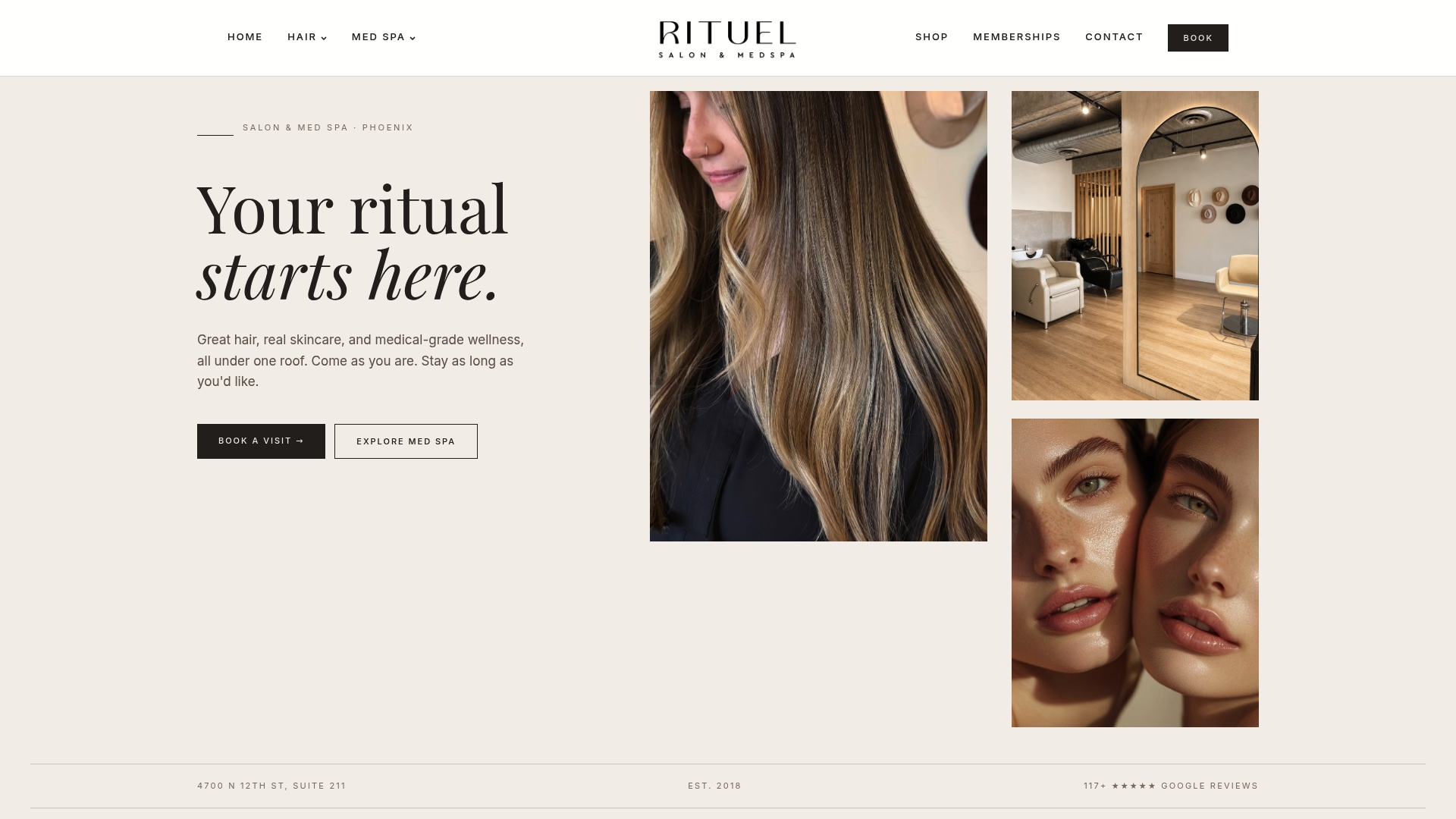
Reading about luxury salon atmosphere elements is one thing. Experiencing them is another. Salonrituel in Phoenix, Arizona was designed from the ground up with every element discussed here in mind: warm layered lighting, curated materials, acoustic calm, signature scent, and a client journey that evolves from the moment you walk through the door.
Whether you are coming in for precision balayage that takes hours of careful technique, a hair color transformation, or a med spa treatment like microneedling or a HydraFacial, the atmosphere at Salonrituel is not an afterthought. It is the experience itself. Located at 4700 N 12th St, Suite 211 in Phoenix's central corridor, Salonrituel is where elevated design meets genuine clinical expertise. Explore the full salon services or book your visit to feel the difference.
FAQ
What are the most important luxury salon atmosphere elements?
Layered lighting, acoustic zoning, premium materials, signature scent, and a choreographed client journey are the core luxury salon atmosphere elements. Cohesion across all of these matters more than any single expensive detail.
How does lighting affect a salon's luxury feel?
Warm lighting between 2700K and 3000K creates a relaxed, welcoming mood that flat overhead lighting cannot replicate. Dimmers and layered light sources allow the atmosphere to shift throughout the day and across different service zones.
Why does clutter undermine luxury perception in a salon?
Visible clutter signals a lack of intentionality, which directly reduces perceived value. Luxury perception depends on consistent style, clean lines, and integrated storage, even when individual furnishings are high quality.
What role does scent play in a luxury salon environment?
A subtle signature scent, diffused consistently throughout the space, becomes part of the brand identity and triggers relaxation. Clean florals, light woods, or fresh citrus work best because they complement rather than compete with service smells.
How do premium salons create privacy without enclosed spaces?
High-end salons use floor-standing mirrors, acoustic panels, and spatial zoning to create intimate client pockets within open floor plans. This approach preserves the airy quality of the space while giving each client a sense of personal territory.